There are many preconceived ideas about vermicomposting: it smells bad, it's too small, it attracts gnats, compost worms escape from the composter...
And yet, vermicomposting is a simple, effective and odor-free way to reduce your waste by 30% and recycle your biowaste into compost and vermicompost, a natural liquid fertilizer for your plants.
Together, let's combat preconceived ideas about composting, and compost at home!
👉 Want to start your vermicomposting adventure? Discover our range of compact, designer composters.
Contents
Myth n°1: Compost smells bad
Fear of unpleasant odors is often one of the reasons why people shy away from composting in their apartments.
Odorless worm composting 🪱
The good news is that vermicomposting (composting with compost worms) is odorless. Compost worms' digestive enzymes remove the smell of decomposition from the waste they digest. Vermicompost smells like humus, like undergrowth.
Bad smells, the sign of unbalanced compost 👃
Bad smells are a sign of unbalanced compost. The secret of a healthy worm compost bin is 50% organic waste and 50% dry waste (which we often tend to forget...)!
🔪 Ceercle tip Ceercle Cut your waste into small pieces! The smaller the pieces, the faster they decompose and the better they are digested by our worm friends.

Myth n°2: Worms escape from the composter
You don't vermicompost in your apartment because you're afraid of coming face to face with compost worms in your kitchen or living room?
I promise, you have nothing to fear 👇
Good news: compost worms stay warm in the compost! 😉
Worm escape is very rare! To live happily, compost worms live hidden 🪱 They prefer to stay nice and warm in your composter, where they enjoy room and board! Incidentally, they're photosensitive and fear the light.
Don't worry, our indoor worm composters are also well designed to keep the worms inside.
Worm leakage = unbalanced compost 🪱
In exceptional cases, worms may try to escape from the composter if living conditions are not optimal. This is a sign of a problem in your compost.
Here are just a few examples:
🍋 Too acidic or too moist: add dry waste.
💦 A too-dry environment: moisten your compost.
🌡 Sudden changes in temperature: in the event of a heatwave, worms, in search of coolness, may fall into the earthworm container. Give your worms shade and damp cardboard!
🪱 Proximity to a source of noise or vibration (such as a washing machine): worms are sensitive to these.
💡 Ceercle tip: Don't want to encounter worms when harvesting your compost? Since worms are sensitive to light, open the lid of your worm composter for a few minutes before harvesting your mature compost. This will allow the worms to hide deep inside!
Myth no. 3: Compost attracts gnats
You don't compost indoors because you're afraid your kitchen or living room will be infested with gnats? Here are our secrets for gnat-free compost 👇
Why are midges invading my compost? 🍌
Well-balanced compost won't attract gnats!
Here are 3 main reasons for their appearance:
1. A compost that is too moist and acidic: it encourages the proliferation of midges.
2. Compost that 's too sweet: as it ferments, sweet waste (such as fruit) attracts them.
3. Biowaste left in the open air before being put in the composter: midges lay their eggs there.
Find the right balance ♻
Prevention is better than cure! Put your waste in the compost quickly to prevent midges from laying eggs.
Keep to a healthy balance when bringing in waste: 50% dry waste (such as cardboard) and 50% wet waste (such as peelings)!
💡 Ceercle tip: When you add kitchen waste to your compost, cover it with an equal amount of dry waste. This will prevent gnats from laying eggs and reproducing!
How to get rid of midges? 🪰
Are midges multiplying around your composter?
Stop adding peelings (especially fruit) for a while. Add small pieces of cardboard to absorb excess compost moisture and eggshell powder to regulate pH. The midge population should rapidly diminish.
Myth #4: It's too small for my waste 🤷♀️
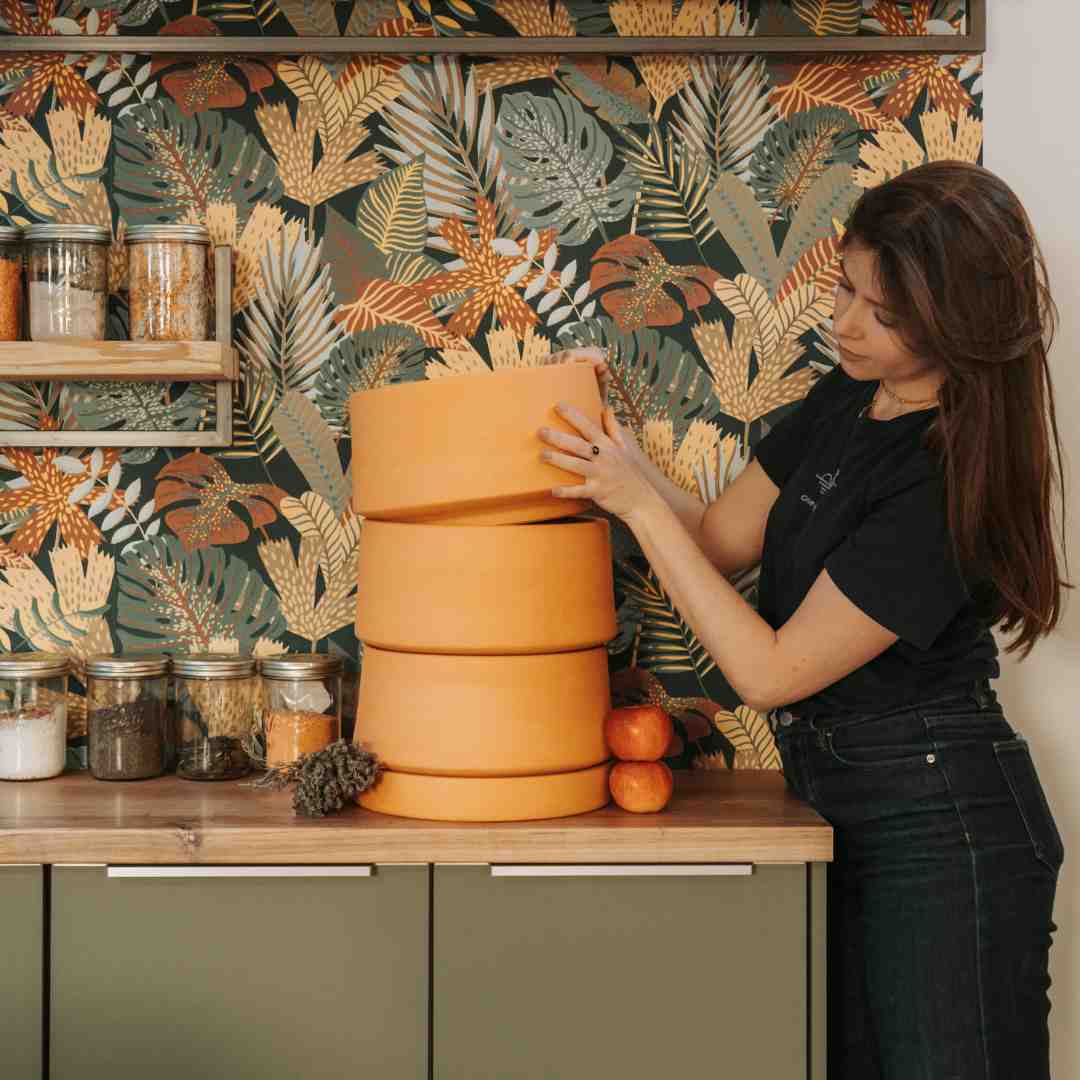
To compost without taking up space, our worm composters are compact... only 35 cm in diameter on the ground! They fit into your kitchen, living room or balcony ♻️
Worried that our worm composters can't hold enough waste for your fruit and vegetable intake? We'll prove you wrong 👇
Choose the vermicomposter that's right for you
Our worm composters can be adapted to your needs. We've created several models to suit the size of your household and your fruit and vegetable consumption!
The composting capacity of our composters varies from 4 to 17 liters, depending on the model, to suit a household of 1 to 6 people.
Customize your Ceercle suit your needs ♻️
Start small, but think big! Our composters are 100% modular and scalable.
As your needs (and desires) grow, you can add more levels to compost or grow more crops!
A process 4 times faster 🪱
Don't let their compact size fool you. Thanks to the super-powers of worms, you can compost up to 80 kilos of peelings a year!
In fact, compost worms eat the equivalent of their own weight every day. This means your waste breaks down 4 times faster than with a conventional composter!