The ultimate guide to vermicomposting
Thinking of switching to vermicomposting? Congratulations! Discover all our top tips in this guide to getting started 🪱
Contents


What is vermicomposting?
What's the difference between worm composting and composting?
Composting is the natural transformation of organic waste into compost by living organisms, both micro (like bacteria and fungi) and macro (like insects).
Vermicomposting is composting using compost worms. Once the micro-organisms have broken down the biowaste, the worms step in to finish the job. They digest our organic waste and produce high-value-added dejecta known as vermicompost. 🪱
What are the advantages of vermicomposting over a conventional composter? 🤔
Vermicomposting offers many advantages over conventional composters:
Faster
With a conventional composter, you need to wait 6 months to 1 year before the process is complete. With worms, it's about 4 times faster.
Easier
Self-maintaining, the vermicomposter is easy to maintain. There's no need to moisten or turn the compost - the worms do all the work for you!
Odorless
It's the worms that, thanks to the enzymes in their intestines, remove the smell of decomposing waste by digesting it.
Perfectly
suited to the city
Vermicomposting is the only solution that can be implemented in apartments, indoors or outdoors, and on a small footprint.
Reduces the volume of waste garbage cans
Vermicomposting can reduce the volume of your garbage can by 30%, or around 80 kg per inhabitant per year.
Compost and vermicompost
Vermicomposting produces vermicompost, a rich soil improver for your plants, and vermicompost, a natural liquid fertilizer.
Recover a significant amount of bio-waste each year
Compost worms can consume the equivalent of their own weight per day! 💪
The amount of biowaste will depend on the capacity of your vermicomposter.
Our composting garden absorbs around 40 kg of peelings and cardboard a year.
Our flowerpot composter can process 30 to 50 kg of biowaste per year.
A kitchen vermicomposter will weigh between 30 and 40 kg. kitchen vermicomposter and 15 kg for the self-fertilizing vegetable garden.
The compact vermicomposterour simplest model, can compost up to 70kg of biowaste per year.
Cultivate and compost in the city (indoors or outdoors)
Easy & Odorless
Handcrafted products
Design
Compact
Modular
Eligible for subsidies
This is an average and may vary according to the season:
- Spring and autumn are the most active seasons for worms. 🌱
- In summer and winter, they slow down their metabolism and absorb waste more slowly. ❄️
Adopt an economical and ecological gesture
Vermicomposting is good for you and good for the planet.
By vermicomposting, you :
- Reduce the volume of your trash 🗑
- Turn your waste into resources: potting soil and natural fertilizer to grow your plants 🌱
- Protect the planet: you avoid incinerating or burying recoverable waste, activities that emit large quantities of greenhouse gases 🌍
- Save money if your municipality implements an incentive tax on waste
Composting must become an everyday gesture
With Ceercle, composting becomes child's play! We organize composting workshops in schools, for local authorities, and for businesses. Contact us to organize a workshop at ceercle.

Getting started with vermicomposting
Where should I place my vermicomposter?
A vermicomposter can be placed indoors or outdoors. Compact, it doesn't take up much space. Perfect for your kitchen, balcony or terrace!

A quick reminder: unlike conventional composters, vermicomposters don't give off unpleasant odours. The worms decompose very quickly, so there's no need to macerate your waste. This absence of odors makes vermicomposters perfectly compatible with indoor use!
Worms thrive in temperatures between 5 and 30 degrees. Indoors, place your vermicompost in your kitchen, garage, cellar...
Outside, place your vermicompost in a place protected from direct sunlight and rain. It will be necessary to protect it from frost in winter. 🥶
Finally, our worm friends don't like noise and vibrations (like the washing machine, for example). It's best to find a quiet place for them - we owe them that much.
At Ceercle, we have a range of indoor worm composters (kitchen, living room, veranda) and outdoor worm composters (balconies, terraces, etc.). We have even designed composters for planting for vegetable gardens or planters! In short, you're sure to find what you're looking for in our store 😉

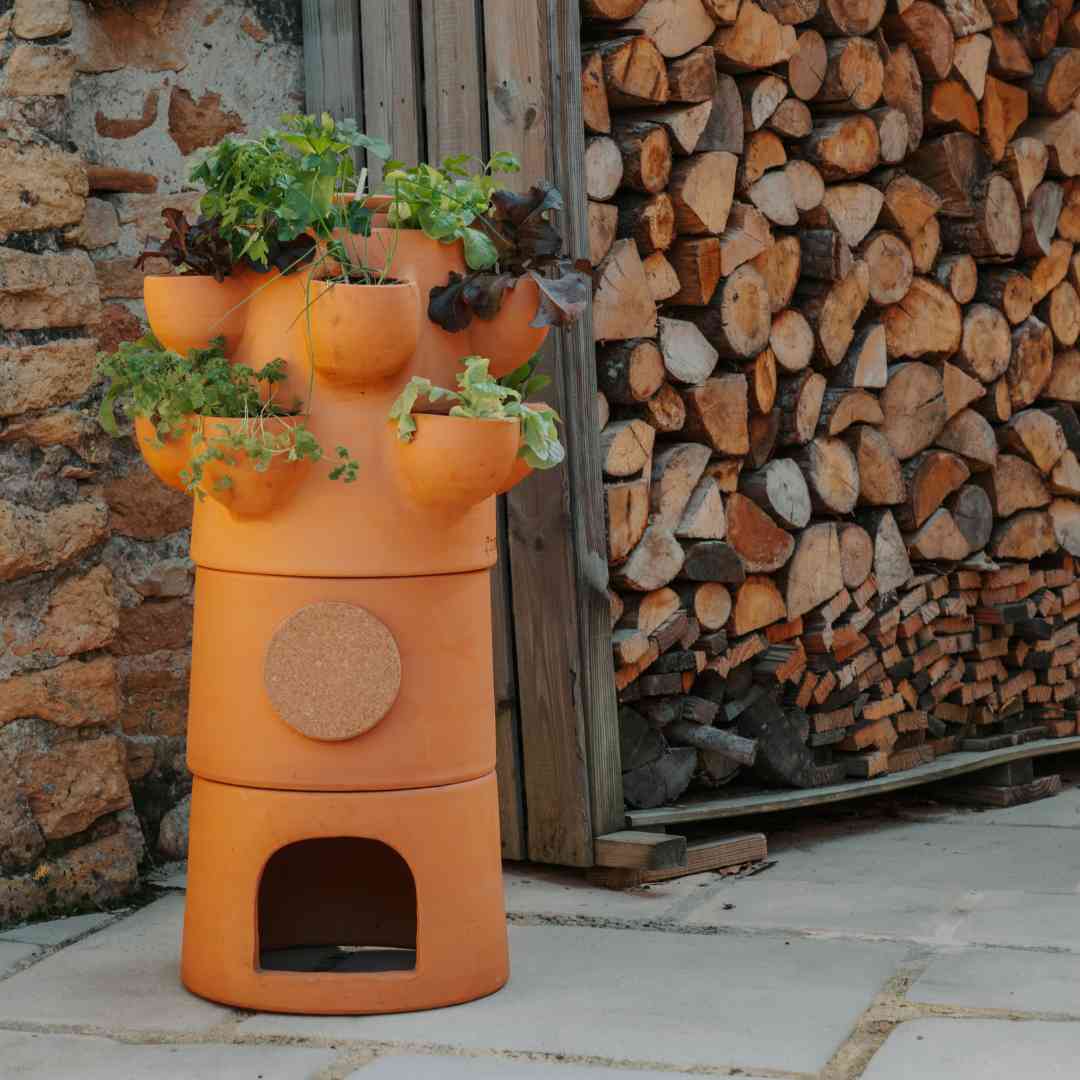

A self-fertilizing vegetable garden for growing and composting in a small space
Easy & Odorless
Handcrafted in Portugal
Design
Compact
Modular
2x more harvests than in pots
How do I get my vermicompost off to a good start?
1. A smooth start to vermicomposting
Starting a vermicomposter takes time. ⏱️
To install your worms, start by placing a layer of cardboard at the bottom of the vermicomposter. Add a little potting soil. Install your worms.
Give the worms time to adapt to their new habitat. To begin with, don't overfeed them.
Our advice: for a month and a half, place a handful of waste per week in your vermicomposter, then increase the volume as your worms reproduce.
THE
VEGETABLE GARDEN NEWSLETTER
Receive monthly tips on how to start vermicomposting and growing food in the city!
2. Maintain a good balance between organic matter and dry matter
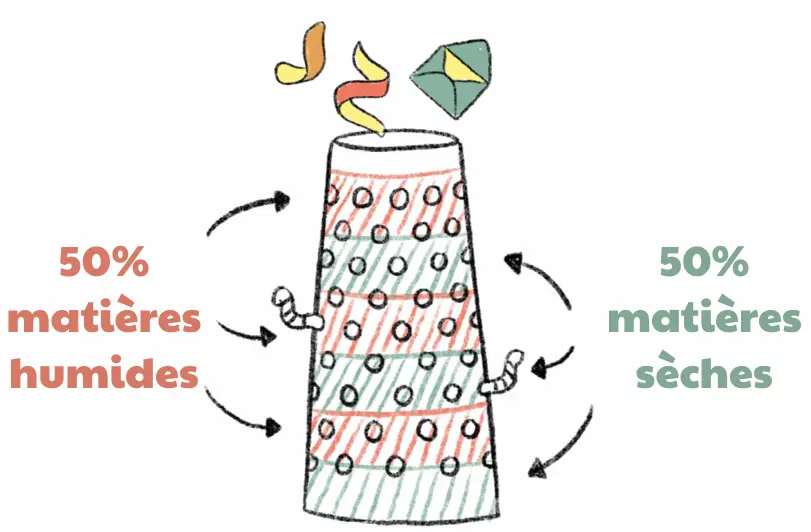
The secret of a healthy vermicomposter is the 50/50 rule!
Put 50% organic waste and 50% dry waste in your vermicomposter. We often tend to forget to add dry matter !
Unbalanced vermicompost can give off unpleasant odours and attract insects. 🪰
Does your vermicompost seem too dry? Too wet? Adjust your inputs according to what you observe. 👀
For example, if your compost seems very damp, it's because it lacks dry matter! Cut up some cardboard into small pieces, and mix your compost so that it absorbs the excess moisture.
3. Cut your food into small pieces
Do you tend to put large pieces in your vermicompost? It'll only take longer for the waste to break down!
Remember to cut your organic and dry waste into small pieces. The smaller the waste, the faster it decomposes and the better it is digested by the worms. ✂️
What waste should go into a worm compost bin?
The rules for vermicompost are slightly different from those for conventional compost.
Indeed, the worms present in vermicompost have a specific diet. 🍏
If they can eat a large quantity of biowaste, there are a few rules to follow to keep them healthy.
1. Wastes authorized for vermicomposting
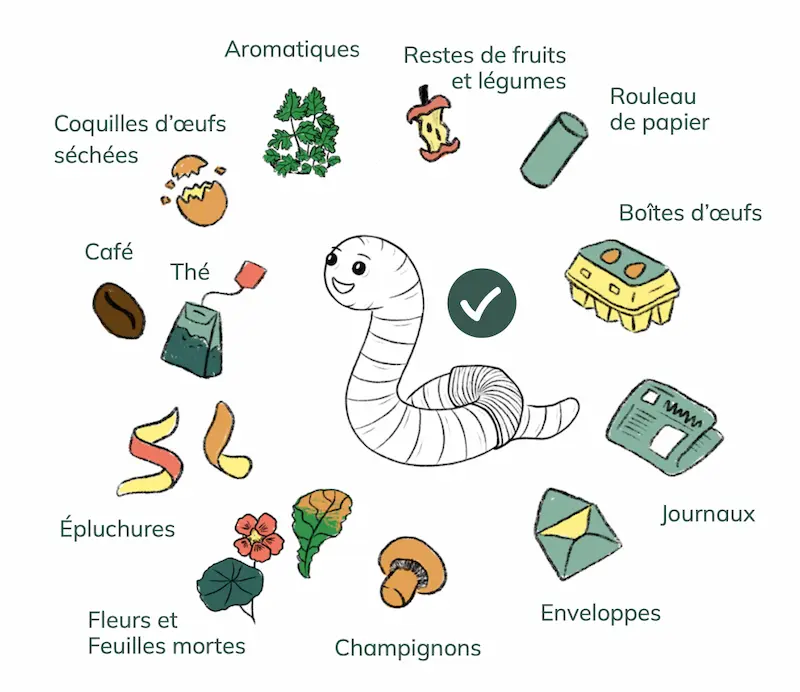
The good news is that the majority of biodegradable plant waste can be assimilated by worms in a vermicompost. 🥳
Wet and dry waste are among the main needs of compost worms.
Here is a short list of biowaste that your earthworms will appreciate:
- Raw and cooked fruits and vegetables (leftovers, peelings), with a few exceptions (see below)
- Crushed eggshells
- Coffee grounds, tea (filters and tea bags if biodegradable)
- Plants, leaves and flowers
- Cardboard
- Egg cartons
- Paper towels and napkins
- Toilet rolls and paper towels
- Paper, newspapers
- Dead leaves
- Sawdust (avoid oak and chestnut)
2. Waste prohibited for vermicomposting
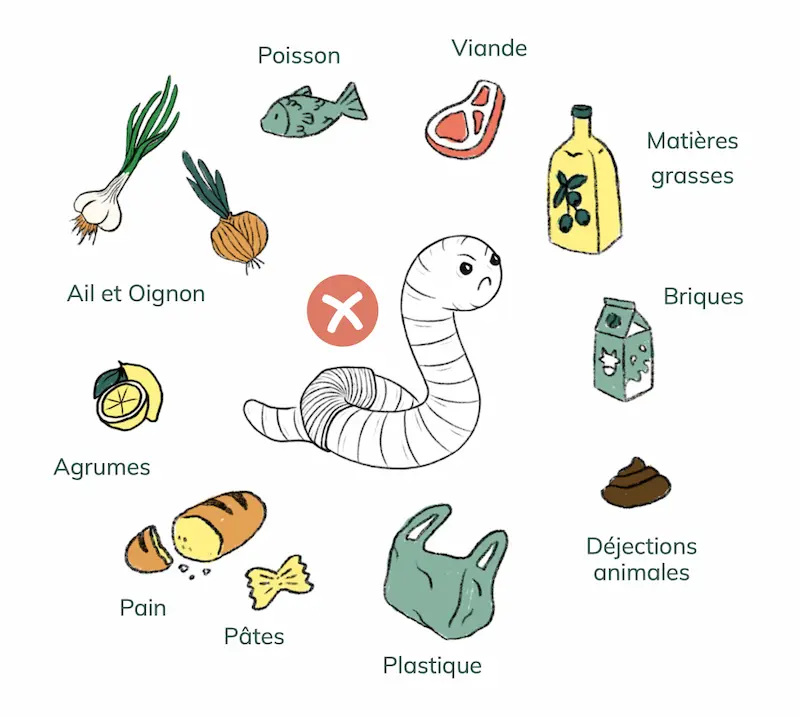
Be careful, some bio-waste should be avoided or even banned in a vermicomposter! ❌
In fact, certain foods or waste products are harmful to worms and vermicompost in general:
- Garlic, onions, shallots, rhubarb: vermifuges
- Plastics: they are not biodegradable
- Glossy paper, plastic-coated cardboard or printed with mineral inks: toxic for worms
Other foods and wastes are indigestible to earthworms, create unpleasant odours and/or attract pests:
- Fatty waste (butter, oils, sauces)
- Meat, fish, dairy products
- Animal excrement
- Starchy foods (bread, flour, pasta, rice): allowed in small quantities only
Finally, some foods are too acidic or take too long to decompose. These can unbalance your compost. The earthworms will eventually suffer, and their population may decline. 🤢
For example:
- Citrus fruits (lemon, orange, grapefruit), too acidic
- Hard skins, hulls and large fruit and vegetable pits, which take a long time to decompose
- Potatoes and sweet potatoes
How do you harvest vermicompost? What are its benefits?
Vermicomposting works in stages:
- The top of the vermicomposter contains fresh biowaste, 🍃
- Next comes waste being digested by worms, 🪱
- And finally, there's the organic matter transformed into compost. 🪴
The first vermicompost harvest takes place around 4 months after the installation of your vermicomposter.
Generally speaking, there aren't many worms in mature compost, as there isn't much left to eat. If you do find a few, put them back in the vermicomposter. Not sure? Here are our tips for making sure your vermicompost is ripe.
Once up and running, you can harvest vermicompost every 2 to 3 months.
Vermicompost is rich in nutrients and micro-organisms. Its odorless consistency is similar to that of potting soil. It's a valuable organic amendment for your plants:
- It boosts plant growth 🌿
- It helps plants resist certain diseases and pests 🐛
- It improves soil structure, promoting water retention and aeration 💧
To use it, add a handful of vermicompost to the surface of your substrate or mix it with your potting soil (1/3 vermicompost, 2/3 potting soil).

What about compost tea?
In addition to vermicompost, vermicomposting produces compost tea or worm tea. 🫖
In our Ceercle vermicomposter, you can collect it in the container located in the base. It will drain out gradually after you water your plants.
It's a natural liquid fertilizer for plants. Be careful, it is highly concentrated. Dilute it in water (about 20 cl per liter of water) to water or spray your plants. You can use it once a week.
Everything you need to know about worms used in vermicomposting
What's the difference between compost worms and garden earthworms?
Only a few species of worm are used for vermicomposting. This is the case of the Eseinia family.
The earthworm is a plow worm. It lives deep underground and digs vertical galleries.
The compost worm, on the other hand, is an epigeic worm. It lives in the first few centimetres of soil, where it feeds on decomposing plant matter. 🍂
Our worms are raised by us in Écully, near Lyon, on our worm farm. To book a tour of our greenhouse and worm farm, please contact us: ceercle.

Do worms reproduce?
Worms are hermaphrodites. They reproduce very rapidly: their population can double every 2 to 3 months.
Don't worry, you won't be overrun with worms. 😉
In fact, their population self-regulates according to their living conditions, in particular the space and food available to them. If less food is available, worms slow down their reproduction rate.
Will my worms survive high heat in summer and low temperatures in winter?
The worms' comfort temperature is between 15 and 25°C.
- Temperatures below 0°C and above 35°C can be fatal. 🥵
- Between 5 and 15°C, worms slow down their activity.
- Between 0 and 5°C, the worms go into hibernation and activity in the vermicomposter stops. ❄️
Our Ceercle worm composters Ceercle the advantage of insulating the worm compost from outside temperatures, both high and low. The layer of compost surrounding the worm compost and the terracotta act as temperature regulators. The terracotta protects the roots and worms from both heat and cold.
For example, last summer it was 30 degrees in our greenhouse, but 25 degrees inside the vermicomposter. In both summer and winter, your worms are well protected, unlike in a conventional vermicomposter. As a result, our vermicomposters are compatible with outdoor use.
In the event of severe frost, we recommend bringing your vermicomposter indoors. In the event of a heatwave, we recommend placing it in the shade. If necessary, line the inside walls of the composter with wet cardboard, to better insulate it from outside temperatures. ⛱️
Can worms escape from the vermicomposter? 😬
If you've just set up your vermicomposter, adventurous worms may try to get out in the first few days. (This is very rare). Once the acclimatization phase is over (about a week), the worms stay warm in the vermicomposter.
If your worms are escaping from your vermicomposter, it's because they're trying to get away from something they don't like. There are several potential reasons for worm escape:
- The presence of deworming or toxic waste,
- Too acidic an environment (add dry waste),
- Too dry an environment (humidify),
- Too wet an environment (add dry matter),
- If the temperature is too high, the worms will flee in search of cooler conditions.
- Proximity to a source of noise/vibration (such as a washing machine), to which they are sensitive.
Generally speaking, worms prefer to stay very quiet, away from light. They are very discreet housemates 😉
How can I be sure that my worms are healthy?
Worms are usually found at the bottom of the compost bin. They move according to their food and avoid light. So it's normal if you don't see them when you open your vermicomposter.
To check that there are still worms in your vermicomposter, you can either :
- Option 1 (not even afraid): Dip your hand into the column and pull out 2 big handfuls of compost, worms should be in there 🪱
- Option 2: Lift and slightly tilt the vegetable garden section and observe if you see any worms 👀
FAQ : Common problems with vermicomposting
Compost that's too wet has excessive acidity. Over time, this acidity leads to unpleasant odours. To avoid this, add enough dry matter to your compost! You can also regulate this acidity problem by adding crushed eggshells, which have the ability to rebalance the PH of your compost.
If you stir up the waste in your vermicompost, you'll see lots of little bugs going about their business.
Many of you are wondering whether these insects are beneficial or harmful. Rest assured, the presence of all these little inhabitants is a good thing! They contribute to the symbiosis of your compost's fauna.
Sowbugs, for example, complement earthworms. They ensure the first stage of decomposition of woody materials (hard waste). So do springtails, mites, nematodes, beetles and millipedes. However, some insects can cause problems...
Compost that's too moist or too sweet (with the addition of fruit waste) encourages the arrival of harmful insects, such as flies and midges. Remember to close your vermicompost tightly. Bring in enough dry matter. By absorbing excess moisture, they help prevent and combat the appearance of insects.
Our tip : when you put kitchen waste in your vermicompost, cover it with at least the same volume of dry waste, such as cardboard. Organic waste tends to attract flies and gnats. Cardboard will keep them away.
Be sure to keep the compost moist enough, as ants prefer dry soil! Putting traps near the composter can also be a solution.
The presence of mold is not in itself a bad sign. Bacteria, protozoa, yeast: these micro-organisms play an essential role in the transformation of compost.
You can, however, control the appearance of mould: a little cardboard to regulate humidity, a little surface stirring to break up the covering effect, and everything should fall back into place!
Worms are very discreet, and you will rarely see them if they are happy in your worm composter. With a Ceercle worm composter, Ceercle can lift the worm composting section of the base to see if there are any worms hiding. If you're feeling brave, you can take a few handfuls of compost from the column and check that there are still worms there!