Worms are the invisible heroes beneath our feet

They recycle organic matter, nourish and aerate our soils, allowing life to thrive.

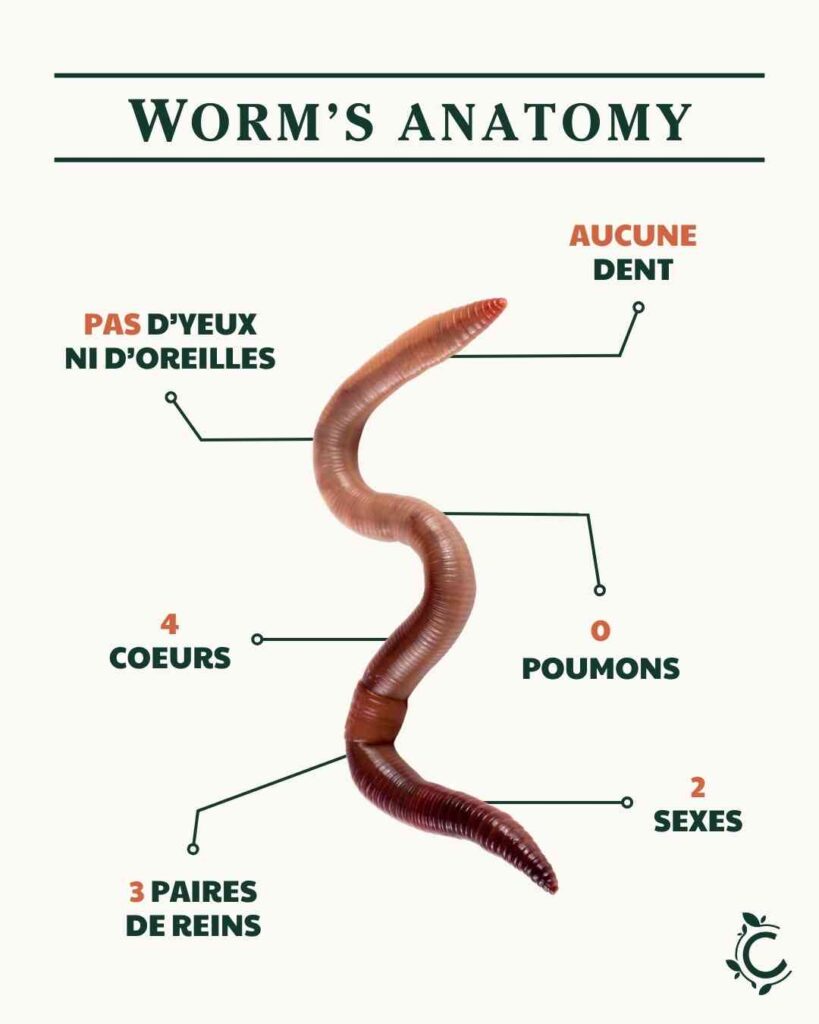
Their anatomy is unique: no eyes, no ears, no teeth, no lungs... but 4 hearts, 3 pairs of kidneys and 2 sexes!
Not very glamorous? Perhaps. Essential? Absolutely.

Odorless composting indoors or outdoors
From €39.00
Easy & Odorless
Handcrafted products
Compact
Modular
Eligible for subsidies
Contents
You have beautiful eyes you know
Eisenia has no eyes, nose or ears. They are useless underground.
It is identified bylight-sensitive organs.
The earthworm has a sense of touch and gravity to orient itself in its galleries. It senses vibrations to flee when a predator approaches.
No arms, no chocolate
Its body is made up of 80 to 120 segments or rings.
These are lined with "bristles" (or hair) on the ventral side, which help it to move.
To crawl, it contracts or relaxes its muscles to lengthen or shorten its body. In this way, it can move up to 60 times its body weight.
A self-fertilizing vegetable garden for growing and composting in a small space
Easy & Odorless
Handcrafted in Portugal
Design
Compact
Modular
2x more harvests than in pots
Skin that breathes
Compost worms have no lungs: they breathe through their skin!
Its body must remain moist and viscous to allow it to breathe. If it dries out, it dies of asphyxiation.
2 times more love
Earthworms are hermaphrodites: they have both male and female reproductive organs.
Following mating, each worm lays cocoons!