You live in the city and don't have a garden? You can compost your biowaste indoors. I can see you coming: "Yes, but I don't have much room in my apartment, a composter is too big, and it attracts gnats...". But there are composting methods adapted to small spaces, without odours or nuisances!
Find out how to compost your apartment! Thanks to our advice and our apartment composters, you can lighten your garbage can by 30% and transform your food waste into nutrient-rich compost.
Contents
How do you compost when you live in an apartment?
You live in the city, you don't have a garden... You're thinking that composting isn't for you? But it's perfectly possible to compost your biowaste indoors, even if you don't have much space. And I promise, without odours or nuisances!
Two composting methods are particularly suited to small spaces, for their speed and absence of odors: vermicomposting and bokashi.
Vermicomposting
Vermicomposting is composting with worms. It's a fast, odorless and maintenance-free composting method, thanks to the action of compost worms. The worms do all the work: they accelerate the decomposition of organic waste and aerate the compost. You harvest nutrient-rich vermicompost every 3 months or so, plus compost tea.
Worm composters can be used indoors, in your kitchen or living room, or outdoors, on your balcony or terrace, for example. You can even compost directly in your plant pots with our plantable vermicomposter!
While there are few drawbacks to a vermicomposter, there are a few rules to follow, such as respecting the worms' diet and maintaining a balance between organic and dry matter inputs. We'll come back to these points in more detail later.

The bokashi
The bokashi is a kitchen composter based on anaerobic (oxygen-free) fermentation. A compost activator, containing the necessary bacteria and microorganisms, accelerates the decomposition of waste in an airtight bucket.
How does it work? The principle is simple. You place a first layer of activator at the bottom of your bokashi, followed by your organic waste. Add a dose of activator and squeeze out the oxygen. Repeat the operation until your bucket is full!
Bokashi also has its advantages:
- Bokashi can be used to compost all types of kitchen waste, including meat and dairy products.
- Thanks to the compost activator, which prevents organic waste from rotting, bokashi doesn't give off unpleasant odors.
- Hermetically sealed, it doesn't attract insects.
- Bokashi islow-maintenance. It doesn't need to be stirred or moistened. It does not require a balance between organic and dry matter.
With bokashi, you obtain compost juice and a compost base, which is not immediately ready for use. We'll tell you more about this later.
How to choose your composter?
It's important to choose the composter that's right for you, according to your needs and desires. Here are a few criteria to consider:
- Location : while a bokashi's preferred location is in the kitchen, a vermicomposter can be installed indoors or outdoors.
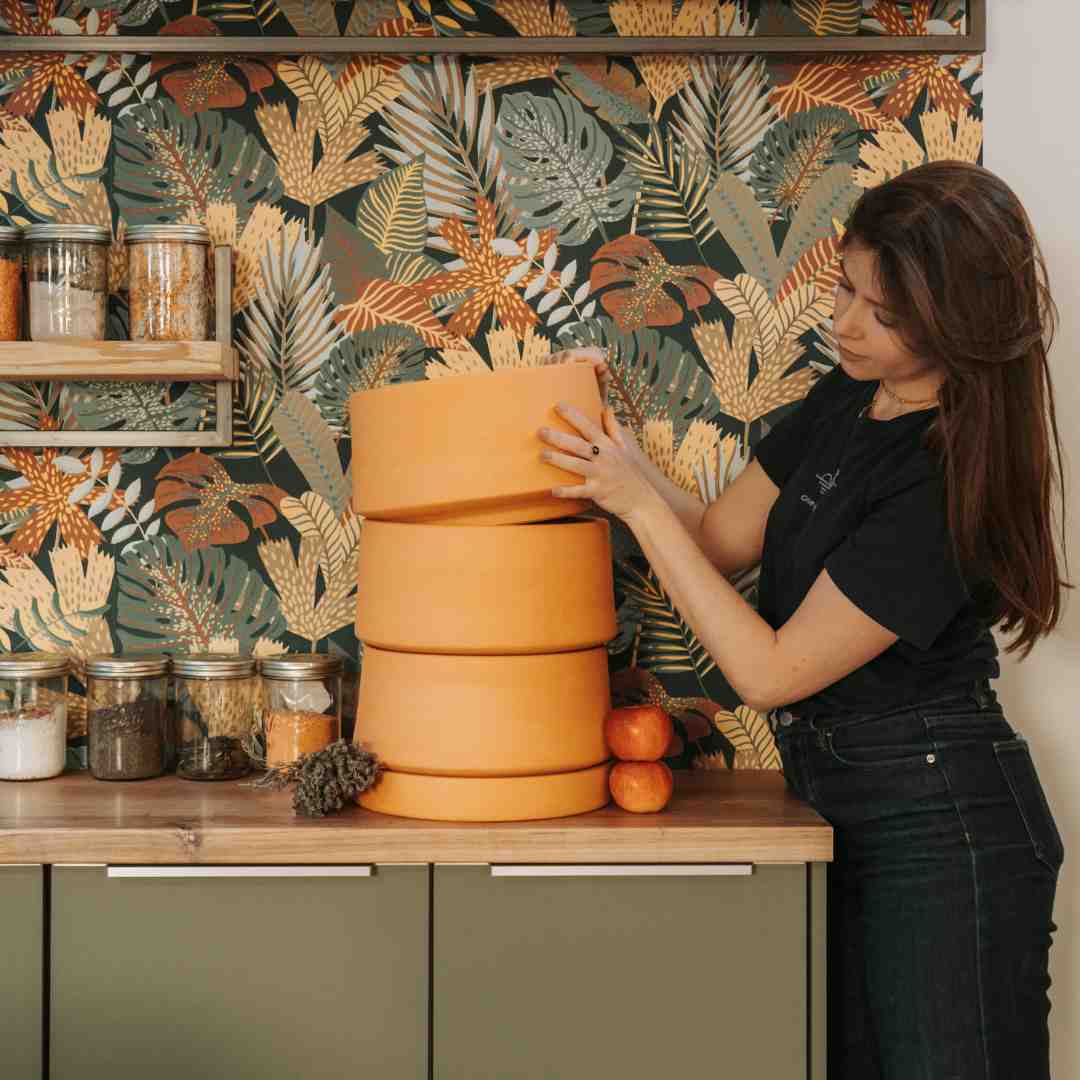
- Space: if you only have a limited amount of space at your disposal, opt for compact composters like our kitchen composter. If you have a balcony, our vegetable garden composter is the model for you!
- Price: find the composter that suits your budget. At Ceercle, start small but think big with our 100% modular composters.
- Composting volume : depending on the size of your composter, you can compost a greater or lesser volume of waste. The ideal size for your composter depends on the number of people in your household and your diet.
- Materials: noble materials such as terracotta and wood are more expensive than plastic. Unlike plastic, terracotta is durable, insulating and aesthetically pleasing.
- Design: choose the composter that best suits the style of your home. A designer composter can become a real decorative object.
Where to place your compost in an apartment?
You can place your composter in the kitchen, in the living room or on the balcony, depending on the space available and your preferences.
- Kitchen: the ideal location! Your composter is within easy reach when you're cooking, for composting fruit and vegetable peelings and leftovers, for example.
- Balcony: if you're worried about the inconvenience of composting, place your composter outside on your balcony or terrace.
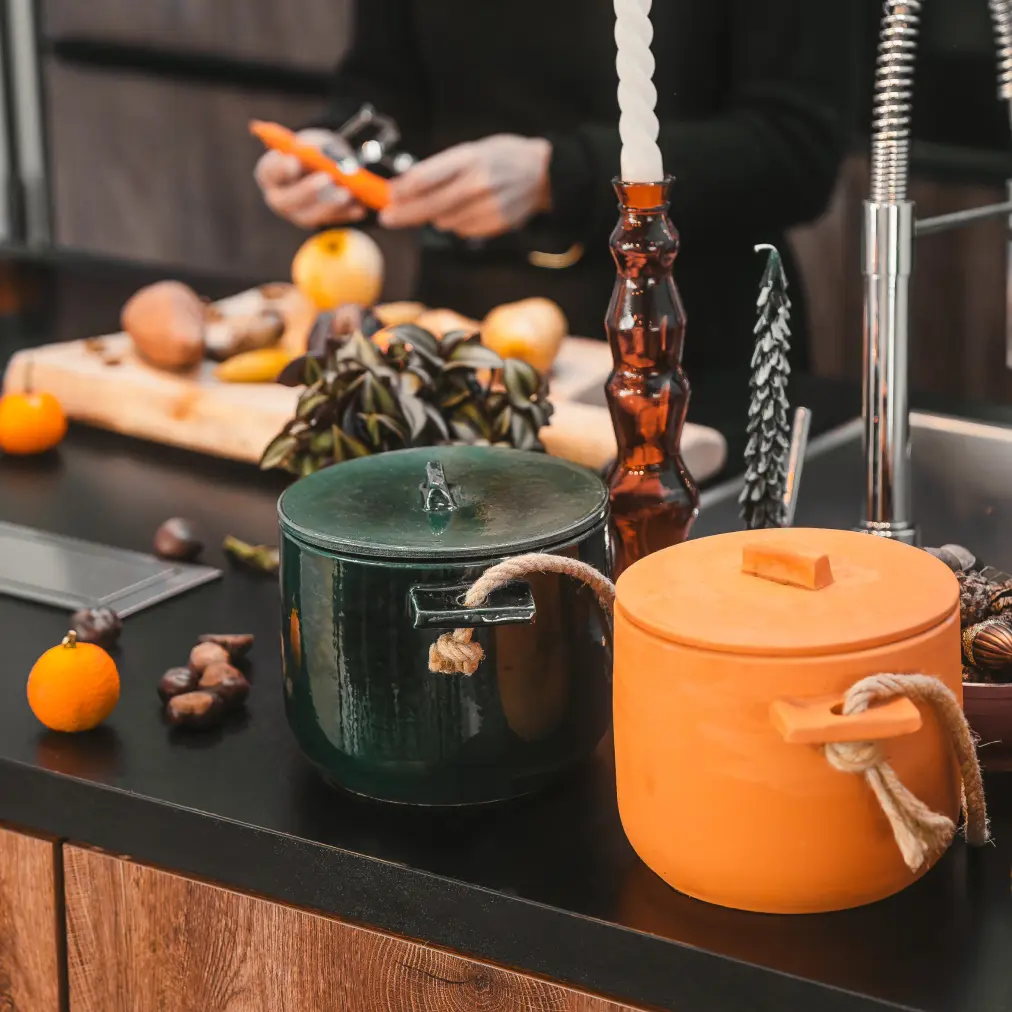
- Living room: because they're often unsightly, composters are usually hidden away in a corner of the home or on the edge of a balcony. However, our designer composters are beautiful decorative objects that will look great in your living room.

How do I compost my apartment?
By composting, you can recycle more than a third of your waste! Small gesture, big impact: 1 tonne of biowaste composted means 1 tonne of CO2 avoided.
What waste is permitted and what is prohibited?
It all depends on the type of composter in your apartment!
In the case of bokashi, you can compost all kitchen waste without exception, including meat and dairy products.
In the case of the vermicomposter, certain types of waste should be avoided, such as deworming foods (garlic, onions, leeks, etc.) and animal products (meat, fish, dairy products, etc.). For more information, read our article: What foods should you put in your vermicomposter?
The right gestures for healthy compost
Fear of unpleasant odours or midge infestation is often a deterrent to composting in apartments. Don't worry, balanced compost doesn't cause any inconvenience. On the other hand, the appearance of unpleasant odours or insects are signs of unbalanced compost.
Here are a few tips for odor-free, nuisance-free vermicomposting:
- Respect a balance in your inputs: the golden rule is 50% organic waste and 50% dry waste (which we often tend to forget...)!
- Cut your waste into small pieces: the smaller the waste, the faster it decomposes and is digested by the compost worms.
- Quickly place your waste in the compost and cover it with an equivalent volume of dry waste to prevent midges from laying eggs.

What to do with your apartment compost?
Discover several ways to use the compost and compost tea produced when you live in an apartment. For more details, read our article What to do with compost?
While the vermicomposter produces ready-to-use vermicompost, the bokashi only produces pre-compost. You need to bury this pre-compost to allow it to finish decomposing. In an apartment, mix it with the soil in your pots or window boxes on your balcony, for example. Alternatively, add it to a collective composter, such as a building or neighborhood composter.
Mature compost is a highly beneficial organic amendment for your plants. It promotes the growth and good health of your plants. It improves the structure of the substrate, as well as its ability to retain water and nutrients.
Don't hesitate to add compost to your potted plants, whether indoor or outdoor:
- Resurfacing : when the soil level in your pots drops, level them with compost resurfacing.
- Repotting: mix ⅓ of compost and ⅔ of soil when repotting your plants.
You can store your compost for up to 3 or 4 months. And if you don't have a green thumb, donate your compost to friends and family, gardening associations, your local authority or via donation platforms.
What about compost tea? It's an excellent natural liquid fertilizer! Just dilute 1 part vermicompost tea with 9 parts water in your watering can. Used undiluted, it would be harmful to your plants. Water your plants to fertilize them!

Conclusion
Composting in an apartment no longer holds any secrets for you! It's perfectly possible to compost indoors, in small spaces, and all without odours or nuisances. By making composting an everyday gesture, you're helping to build a greener world.
👉 Ready to get started? Check out our range of compact, design-oriented home composters.