Starting a vermicomposter takes time!
And it's frustrating, but you have to accept it and be patient. There are lots of things that happen invisibly to you, like the appearance of micro-organisms. Here are 6 tips to speed up the process and achieve balanced compost.
Contents
1 - Don't stuff your column 😉
Many of you are calling us for help because the column level isn't falling fast enough. Butterfly minute!
Your worms need to adapt to their new habitat. To help them do this, don't overfeed them while your waste decomposes and your worms reproduce... 💚
In fact, to start with, there are between 30 and 50 worms in a bag (adults as well as babies who need to grow). And each worm digests its own weight per day... the more of them there are, the faster they'll digest your dry, organic waste. It's mathematical 😉.
Our advice: for 1 and a half months, 1 nice handful of waste per week, then you'll increase the volume as your worms reproduce 🪱.
On average, we say that you harvest your first amendment (aka compost) after 4 to 6 months, a little more patience ⏱️!
2 - Maintain nitrogen/carbon balance
Too dry? Too wet? You ask us a lot of questions about the substance of your compost. And that's normal. At the same time, there's nothing simpler than a 50/50 rule to guarantee balanced compost ⚖️. 50% organic matter such as peelings, 50% dry matter such as cardboard or paper towel rolls 📦.
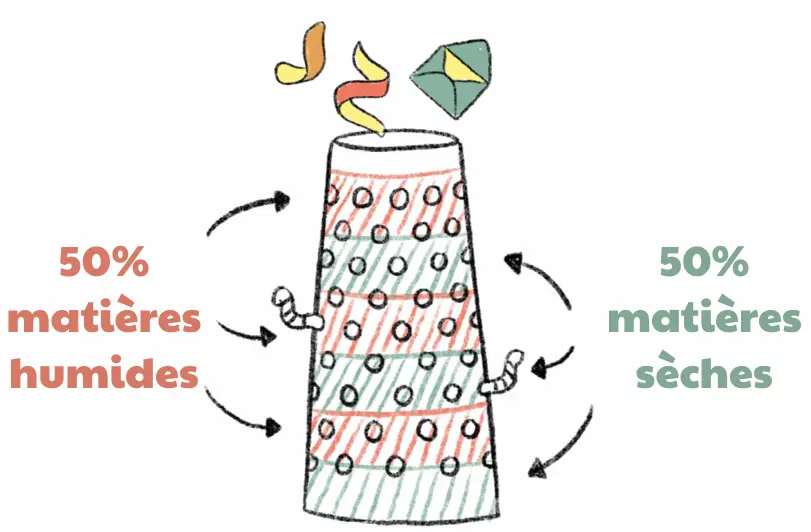
Our advice: When you put in your kitchen waste, you need to cover it with at least the same volume of dry waste.
Cardboard will never create problems in a vermicomposter, whereas organic waste can. So it's always better to put in more cardboard!
The other advantage of putting cardboard on top is that you avoid contact between flies and organic waste, which can't lay eggs.
How to achieve balanced compost?
We recommend alternating between 50% organic waste (salad, peelings, etc.) and 50% dry waste (cardboard, paper, etc.). It's up to you to observe your compost and adjust according to your perceived needs.
If your compost seems very damp and muddy, it's probably because it lacks cardboard to absorb moisture. Add some cut into small pieces and mix your compost (by hand for the bravest, or with a utensil 😉 ).
Wet waste
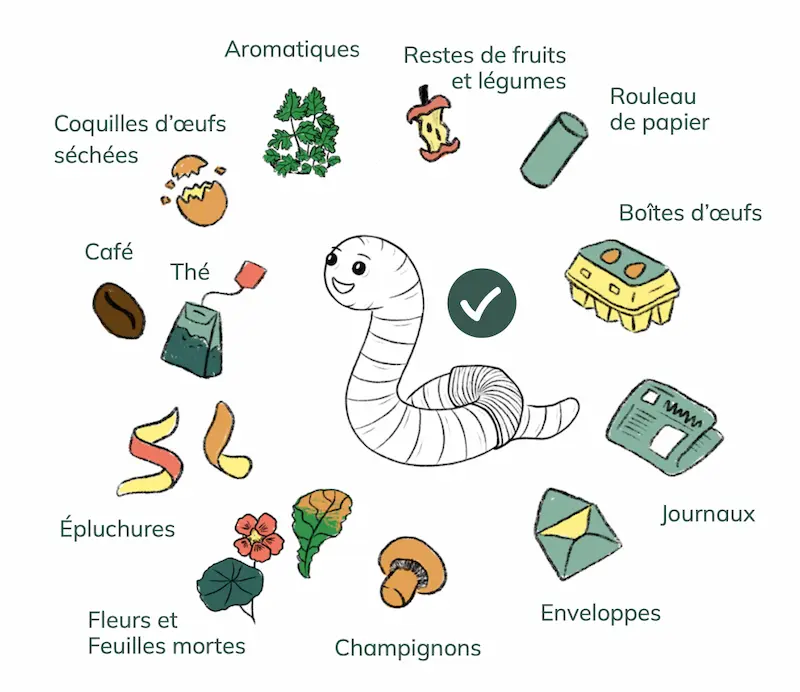
We often think of peelings, but there is a wide variety of wet waste to put in the vermicompost:
- Crushed eggshells
- Mushrooms
- Peelings
- Dead plants and flowers
- Coffee grounds
- Tea (and tea bags if biodegradable)
Dry waste
Also known as brown or carbonaceous waste, dry waste is essential for a balanced vermicompost:
- Cardboard
- Egg cartons
- Paper towels and cardboard rolls
- Paper, newspapers
- Dead leaves
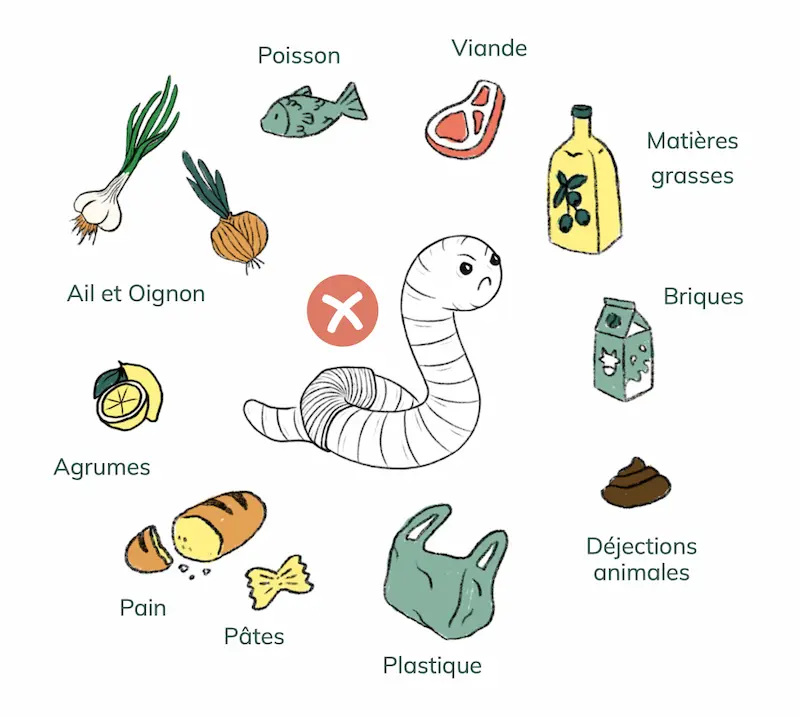
Prohibited waste
Do not add this type of waste to your compost, as it may :
- Having bad smells
- Unbalanced compost
- Reducing the number of earthworms
3 - Cut your waste into small pieces
Wondering why we've created a little hand-sized circle to put your garbage in? ♻️
It's not JUST for looks, it's been thought up by our designer to prevent you putting too big pieces in the column 😉!
Because we know you, you're sometimes a bit in a hurry 😊
The more your garbage is cut up into smaller pieces, the faster it will decompose, and the faster your worms will digest it.
Our tip: Cutting everything into small pieces is a little reflex to get used to, but once you do, you won't even notice it's there. It becomes automatic!
4 - Don't panic if there are small bugs
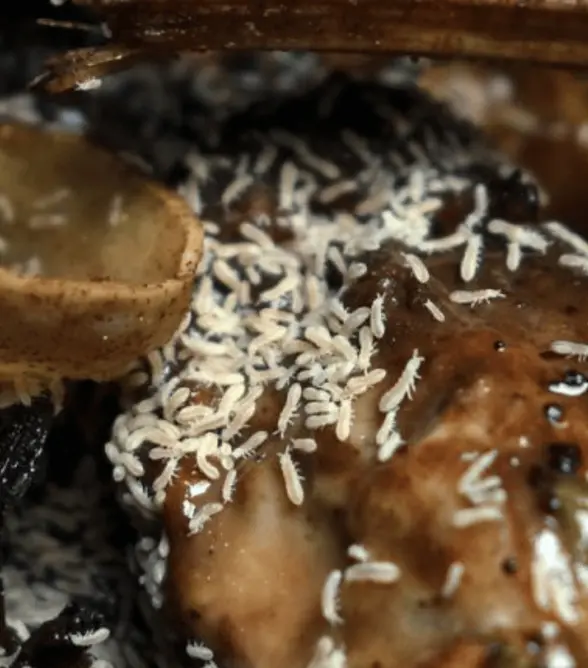
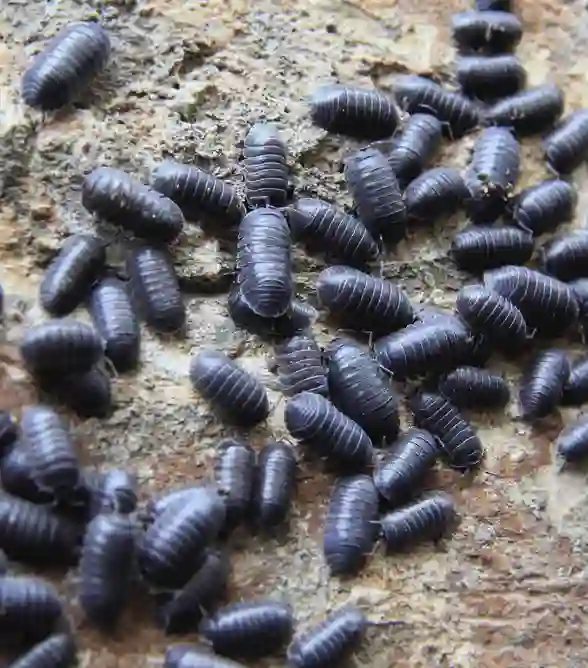
If you stir up the waste from your vermicompost, you'll see lots of little creatures at work.
You may be wondering whether these animals are beneficial or harmful. Rest assured, the presence of all these little inhabitants is a good thing! They contribute to the symbiosis of your compost's fauna.
For example, sowbugs are complementary to earthworms. They ensure the first stage of biowaste decomposition. In the same way, springtails, millipedes, ketoine larvae... are detritivorous insects!
For more details, see our article "Compost insects".
5 - Mould? Nothing could be more normal!
Bacteria, protozoa, yeast - there are also micro-organisms that can only be seen under a microscope, but which play an equally essential role in the transformation of compost!
Some fungi form filaments which, as they accumulate, end up not going unnoticed: these are molds, which appear in particular on fruit and other damp waste.
6 - Join the private Facebook group 🌱
Despite all our advice, are you still having trouble?
The good news is that we won't leave you in the lurch 🤝.
By joining the private Facebook group Le Ceercle 🌱, our experts will guide you through the process of vermicomposting ♻️.
And you can even chat with the Ceercle community 💚
So don't hesitate to join us and ask your questions 😉
Did you kill your worms? 😱
You can always pick up a refill 🐛
Well, we're not going to tell you that we're rejoicing, but a fault confessed, half forgiven 😉💚
And our motto: it's by doing that you learn.
First step: check if they're still alive
How? Simply by removing two handfuls of compost, and for the more sensitive ... you can even use a large spoon to inspect if there's any life.
Second step: take a worm refill if necessary
If no signs of life appear, we've got a solution, but just this once eh 😉 ! We're counting on you to take better care of these little beasts in the future, tell yourself it's like having a pet at home 🏠.
Our solution: A 500g bag of compost worms bred by us in Lyon. You'll find adults, youngsters and even eggs. And all the soil microfauna you need to get your vermicompost off to a good start 🪴