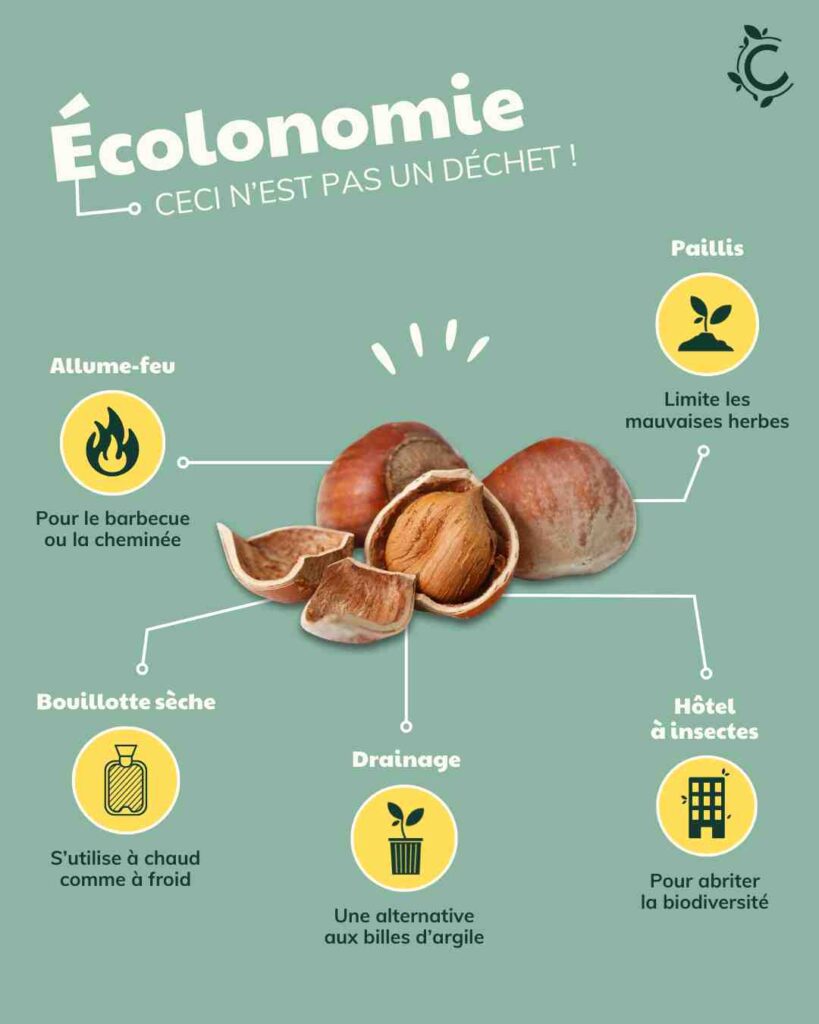
Like to eat hazelnuts? Recycle the shells instead of throwing them away!
Hazelnuts are full of benefits: they're rich in vitamin E, magnesium and good fatty acids.
But their shells are also worth a look. They can be reused both at home and in the garden, for economical and ecological tips.
So how do you recycle hazelnut shells?
Odorless composting indoors or outdoors
From €39.00
Easy & Odorless
Handcrafted products
Compact
Modular
Eligible for subsidies
Contents
5 ways to recycle hazelnut shells
Say goodbye to waste, and hello to zero waste! Discover 6 clever ways to reuse walnut and hazelnut shells.
🔥 An eco-friendly firelighter
Hazelnut shells make excellent natural firelighters. Ideal for quickly starting a barbecue or chimney fire, they are a healthy, environmentally-friendly alternative to chemical firelighters.
For efficient lighting, use the reverse method: lay out the wood first, then add the hazelnut shells on top. Light with a simple match: the fire will burn quickly, cleanly and with very little smoke.
🌱 Good drainage for your plants
Hazelnut shells are an excellent natural alternative to clay balls for draining flower pots, whether indoors or in the garden.
Simply crush them into small pieces and place them at the bottom of your pots or planters. They help water to run off properly, prevent stagnation and protect roots from rotting.
Once shredded, you can also mix them into soil that is too heavy or compact. They naturally lighten the soil and improve its drainage capacity.
👩🏻🌾 Natural mulch in the garden
While mulches are often made from straw, bark or wood shavings, hazelnut shells are an equally effective, and far more original, option.
In the garden, they can be used as a decorative, long-lasting mulch. Once crushed, spread them in an even layer over the soil: they limit weed growth and help stabilize soil temperature.
A small drawback to be aware of: they retain less moisture than conventional mulches, but their longevity and aesthetic appeal make them an excellent choice.
🛏️ A dry hot water bottle
Recycle hazelnut shells into dry hot water bottles! A more sustainable alternative to water-filled hot-water bottles. It's an essential accessory for warming your bed or relieving muscular pain.
On your needles:
- Take two rectangles of fabric. Place them together, right sides together. Sew the edges together, but leave an opening of about 10 cm on one side so you can turn the hot water bottle inside out and fill it.
- Turn the fabric right side out so that the seams are on the inside. Press carefully to flatten the seams.
- Fill the hot-water bottle with hazelnut shells to the desired quantity. Don't forget to leave a length of fabric to close it.
Heat the hot water bottle in the microwave, in the oven or on a radiator to enjoy its comforting warmth.
🐞 An insect shelter
One last idea for the road: create insect hotels using hazelnut shells! A small gesture for threatened biodiversity, especially in cities.
Here are 3 simple ideas for recycling hulls into a refuge:
🪵 On the ground: scatter the shells in a quiet corner of the garden, away from traffic. They'll serve as an ideal hiding place for ladybugs and other insects, especially in winter.
🏡 In an insect hotel: add them to the compartments alongside natural materials such as pine cones, straw or bamboo stalks.
🌳 Hanging: slip the hulls into a small net or fabric bag and hang it from a tree branch. Some species like high shelters to protect themselves.
A simple gesture to welcome life into the garden!
♻️ Hazelnut shells: to compost or not to compost?
And why not compost your hazelnut shells?
Although particularly hard and slow to decompose, these shells (like walnut or almond shells) play an important role in compost. They create air pockets that aerate the material and contribute to a good structure. Rich in carbon, they provide the dry matter essential to compost balance.
To accelerate their degradation, don't hesitate to crush them before adding them.
👉 Want to give your waste a second life? Discover our range of apartment composters, compact, attractive and 100% adapted to city life.
A self-fertilizing vegetable garden for growing and composting in a small space
Easy & Odorless
Handcrafted in Portugal
Design
Compact
Modular
2x more harvests than in pots