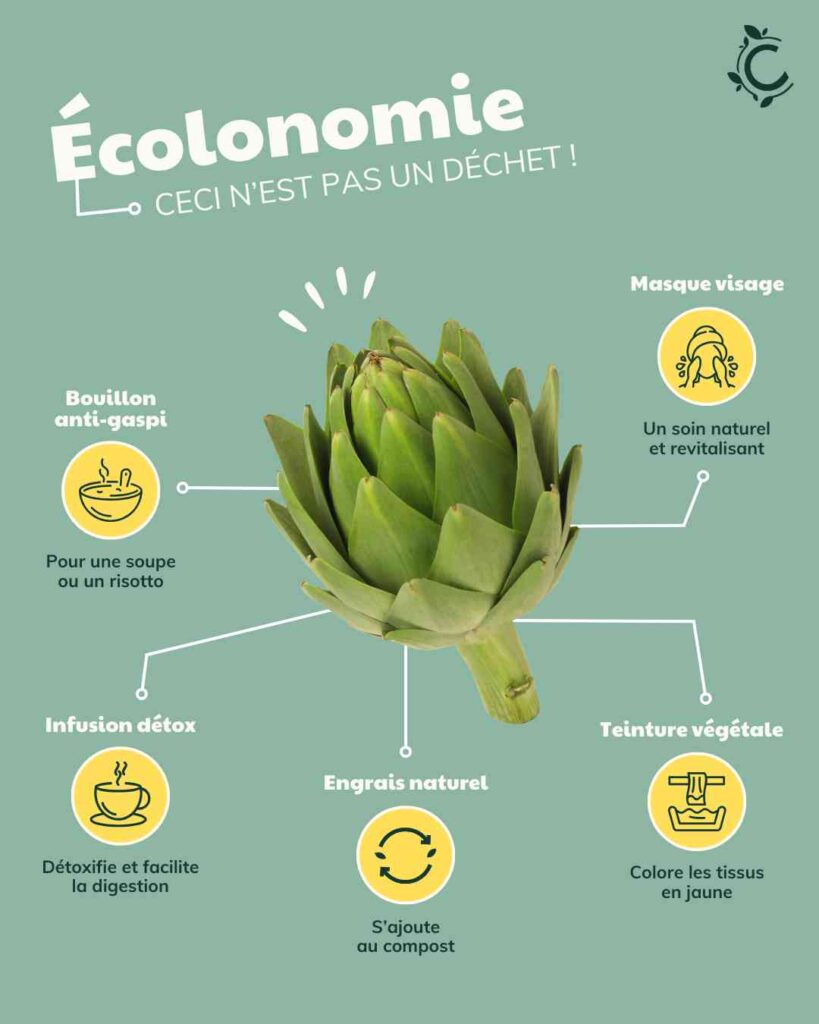
Don't throw away your leftover artichokes! They can still be used.
Artichokes are excellent for your health. Rich in fiber, antioxidants, vitamins and minerals, it is a true ally of well-being. It promotes good digestion, helps regulate cholesterol and stimulates the liver.
More often than not, our reflex is to throw hard leaves, tails or hay in the garbage can.
Rather than throwing them away, why not give them a second life? Discover all our tips!
So how do you recycle leftover artichokes?
Odorless composting indoors or outdoors
From €39.00
Easy & Odorless
Handcrafted products
Compact
Modular
Eligible for subsidies
Contents
5 ways to recycle leftover artichokes
Say goodbye to waste and hello to zero waste!
Discover 5 economical and ecological ways to reuse your artichoke peelings.
🥣 An anti-gaspi broth
Turn your artichoke peelings into zero-waste broth for soups and risottos!
- Add your peelings to a saucepan filled with water.
- Bring to the boil for 2 to 3 minutes.
- Lower the heat and cook for an hour.
- Strain. Add white vinegar, salt and cream to break down the bitterness of the broth.
🎨A vegetable dye
Artichoke leaves can be used as a vegetable dye for fabric. They produce yellow tones.
The most suitable textiles for vegetable dyeing are natural ones such as wool, cotton, linen and silk.
- Proceed with the mordanting process, a key step that will enable the color to adhere better. Place the textile in a water bath with white vinegar and leave to soak for 24 hours. Rinse off.
- Finely chop your artichoke leaves, then place them in a saucepan. Add about three times their volume in water. Bring the mixture to the boil, then simmer over low heat for an hour.
- Filter your water to remove any bits of plant material.
- Dip your textile in the dye. Leave it to soak for several hours, ideally 24 hours for more intense color. Remember to stir regularly to obtain an even shade.
- Remove the fabric from the dye and rinse in cold water until the water runs clear.
- Leave to dry naturally in the open air and shade.
Wash at a maximum temperature of 30-40°C to preserve color longer.
🌿 A natural face mask
Beyond its nutritional virtues, artichoke is a true beauty ally. Rich in antioxidants, vitamins and minerals, it helps purify the skin, combat excess sebum and prevent skin aging. It acts as a natural detoxifier, ideal for combination to oily skin.
- Gather a small handful of cooked artichoke leaves.
- Blend until smooth.
- Add a teaspoon of honey.
- Apply the mixture to a clean face, avoiding the eye area.
- Leave on for 15-20 minutes.
- Rinse with warm water.
🍵 A detox herbal tea
Once you've eaten your artichoke, don't throw away the remaining leaves! They can be used to make a herbal tea with multiple benefits.
- Pick about 10 to 15 g of leaves
- Place them in a cup and pour boiling water over them.
- Leave to infuse for 15 minutes
- Strain and enjoy gently.
To reap its benefits, consume it preferably at the end of a meal.
Artichoke leaf infusion is renowned for its detoxifying and diuretic properties. It helps to ease digestion and reduce bloating, and can also relieve rheumatism.
Ceercle tip Ceercle if you still have leaves to hand, simply leave them to dry in the open air. They will keep very well for your next homemade infusions!
A self-fertilizing vegetable garden for growing and composting in a small space
Easy & Odorless
Handcrafted in Portugal
Design
Compact
Modular
2x more harvests than in pots
♻️ A good addition to compost
And if not, compost your leftover artichokes.
The inedible parts (the tail, the hard part of the leaves and the hay) can be composted very well. Remember to cut the tail into small pieces to facilitate decomposition.
With a little patience, this bio-waste can be transformed into an organic amendment to nourish your plants!
👉 To make the most of your waste, think about composting! Discover our range of composters compact and stylish.